




Shell and pearl are organic materials. They are not fragile, but they are not metal either, and the two things that age them fastest are chemicals and friction. Here is the whole care routine, which takes about a minute.

What you are actually caring for
Nacre — mother of pearl — is not a stone. It is roughly 82–86% aragonite, a crystalline form of calcium carbonate, laid down in microscopic platelets and bonded by an organic protein called conchiolin, with a few percent water held inside the structure. Under magnification it is a brick wall: aragonite bricks, conchiolin mortar, stacked in offset layers. That architecture is why nacre throws rainbow light instead of simply reflecting it, and it is why every rule below exists.
Two numbers explain most of the routine. Nacre sits at 2.5 to 4.5 on the Mohs hardness scale — softer than the quartz dust, at 7, that settles on every surface in a house. That is why dry-wiping a dusty pair puts fine scratches into the surface, and why rinsing first does not. And because aragonite is calcium carbonate, acid dissolves it: perfume, hairspray, perspiration, lemon, vinegar and the chlorine in a pool all etch the surface and take the lustre with them. Nothing polishes that back. Nacre is a skin, not a coating — once a layer is gone it does not return.
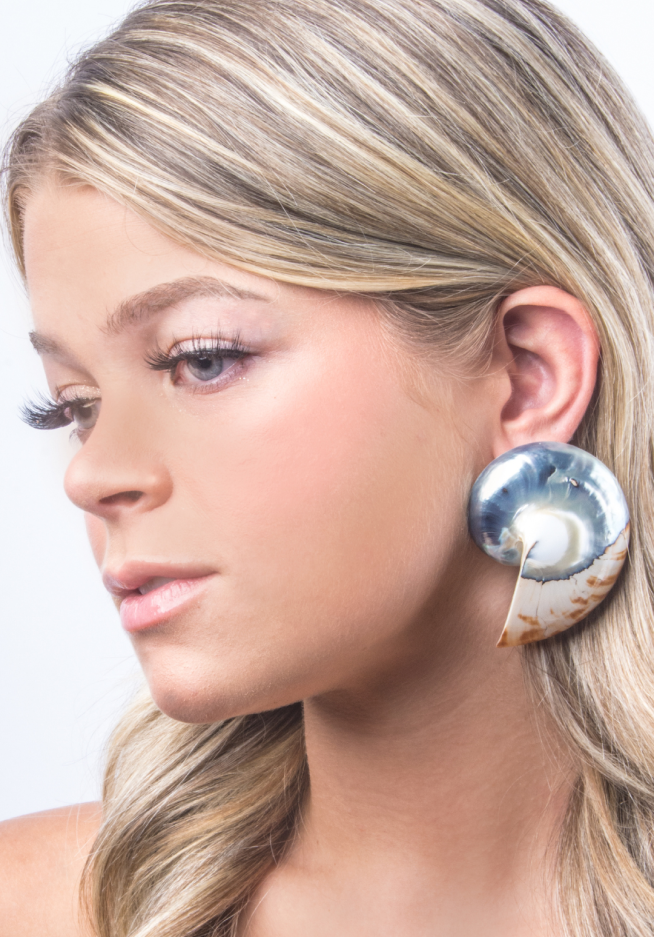
The same is true of the shells we set. A nautilus, a turban, a scallop: all of them are the same calcium carbonate and the same protein, which is why the routine for a shell earring and a pearl drop is identical.
Why the three prohibitions are absolute
No ultrasonic cleaner. An ultrasonic bath works by collapsing microscopic bubbles against the surface of a piece. On a diamond that is harmless. On a layered composite held together by protein it drives the layers apart — nacre can craze, lift or shatter outright, and the damage is often invisible until the piece is dry. The Gemological Institute of America’s guidance on this is unambiguous: never.
No steam, no heat. Nacre holds a few percent water inside its structure. Drive that out with steam, a hot dashboard or a beach bag in full sun and the protein matrix shrinks; the surface crazes into fine cracks. Sun on the skin is fine. Heat in a closed space is not.
Nothing abrasive. Toothbrushes, baking soda, jewelry dips and polishing compounds are all harder than 4.5 on the Mohs scale, which means every one of them cuts nacre rather than cleaning it. A soft dry cloth, or a barely damp one, is the entire toolkit.
Before you put them on
Jewelry goes on last. Perfume, hairspray, sunscreen and moisturiser all contain solvents or oils that dull nacre and, over months, can cloud it. Apply everything, let it dry, then the earrings.
Salt water and pools
A swim will not ruin them, but do not leave salt or chlorine to dry on the shell. Rinse in cool fresh water, then pat dry with a soft cloth. Never soak them — the settings are hand-set and prolonged water can loosen a bond over time.
Sun
Shell and pearl are happy in sunlight; that is where the nacre does its best work. Heat is the issue: do not leave them on a hot dashboard or in a beach bag in full sun for hours. Nacre can dry and craze.

Cleaning
A soft, dry cloth after every wear is enough. For a proper clean, a barely damp cloth, then dry. No jewelry dips, no ultrasonic cleaners, no toothbrushes, no baking soda — every one of those is abrasive or chemical enough to mark nacre.
The metal
925 silver and gold vermeil tarnish slowly with time and air. A silver polishing cloth brings both back; keep it away from the shell itself. Solid 18K gold needs nothing beyond the dry cloth. Vermeil is a layer of gold over silver — it is durable, but the polishing cloth, not liquid polish, is what preserves it.
Storage
Flat, separate, and dark. Each pair in its own pouch or compartment so the shell edges do not rub against metal. The box we send them in is designed for exactly this. If you store them in a humid bathroom, add a small silica packet.
Screw backs and omega backs
Vintage screw backs should turn freely; if one stiffens, a single drop of light oil on the thread, wiped off, restores it. Omega push-backs are hinged and should click; if one loosens over years of wear, we can retension it.
When to send them to us
A loose shell, a stiff fitting, a scratch you would like polished out of the metal: send them back. Everything we make is set in our Austin studio and we would rather look at it than have you try a repair at home. Vintage pieces from the Vintage Collection we treat more conservatively — patina is part of their history and we do not polish it away.
Most of what is in the Seashell Chic and Nautilus collections will last a lifetime on this routine. The Small Two-Toned Nautilus pair pictured has been worn most days for two years.