



Lily Frank Jewelry was founded in 2023 by Afsaneh Taki — a made-to-order fine jewelry atelier in Austin, Texas, working with real natural shells, cultured pearls, sterling silver, gold vermeil, and solid 18k gold. Every piece is made by Afsaneh herself, with the support of fellow jewelry mentors in the Austin community.
The brand began the way most considered design practices do: at the end of a long apprenticeship in adjacent disciplines, not the beginning. Before there was a jewelry line, there were decades of close work with materials, garments, vintage textiles, and the small machinery of fashion.

A Texan With a Wide Map
Afsaneh was born in Texas. Her childhood unfolded between Florida, New Mexico, El Paso, and Austin — a sequence that means coastline, desert, border city, and capital, in roughly that order. Adulthood took her further: New Orleans, New York, Philadelphia, Dallas, Miami, and eventually back to Austin, where the brand is now based.
Long before the brand had a name, Mexico was part of the story. Afsaneh is half Mexican, with family roots tracing back to the silver miners of Batopilas, deep within the Barrancas del Cobre — Mexico’s Copper Canyon. That connection lives most visibly in the Vintage Collection: a love of Mexican silver, its weight, patina, hand-worked surfaces and unapologetic scale, shapes every piece she collects.

Each of those cities left its own sediment. Florida supplied the coastline that recurs through the jewelry. New Mexico and El Paso supplied the material vocabulary of the desert Southwest — natural color, textured surface, restraint. New York and Philadelphia supplied an education in scale. Austin supplied the patience to actually build something.
"Heritage is Persian and Mexican. Both influence the work — its color sense, its insistence on texture, its comfort with materials that show their origin.
Fashion Design at UT
Afsaneh studied fashion design at the University of Texas. The formal training gave her the construction vocabulary; what came next gave her the material literacy.
She worked with Marc Jacobs and Urban Outfitters as a main contractor — sourcing vintage at scale for two of the more material-literate fashion houses in the country. That work happened under her own banner, Recollect Vintage: a buying practice with the eye of a curator and the logistics of a supplier.
The vintage years taught a particular discipline. Every piece she touched had a history; nothing was generic. The job was to recognize what was good — to develop the eye that lets you separate a real garment from a copy of one, an interesting shell from an ordinary one, a freshwater pearl with real nacre from one without it.

The Sewing Store
Before the jewelry, Afsaneh owned and ran a sewing-supply store in Austin — thread, notions, the small infrastructure that makes garment construction possible. The shop served Austin's working makers: dressmakers, costume designers, alterations specialists, hobbyists serious enough to need real materials.
The store extended what she already knew about fashion and vintage into a third discipline: the supply chain itself. What thread tolerates what stitch. Which notions hold up to wash and wear. Which suppliers are reliable. That kind of operational fluency is invisible in a finished piece, but it is what makes a piece reliable rather than promising.
Why Jewelry, Why Now
By the time Lily Frank Jewelry launched in 2024, Afsaneh had spent years inside fashion construction, vintage sourcing, and sewing-supply retail. Jewelry was the natural next move: smaller scale, longer-lived material, no seasonal cycle, and a category where the kind of close attention she had been giving textiles could apply directly to shell and pearl.
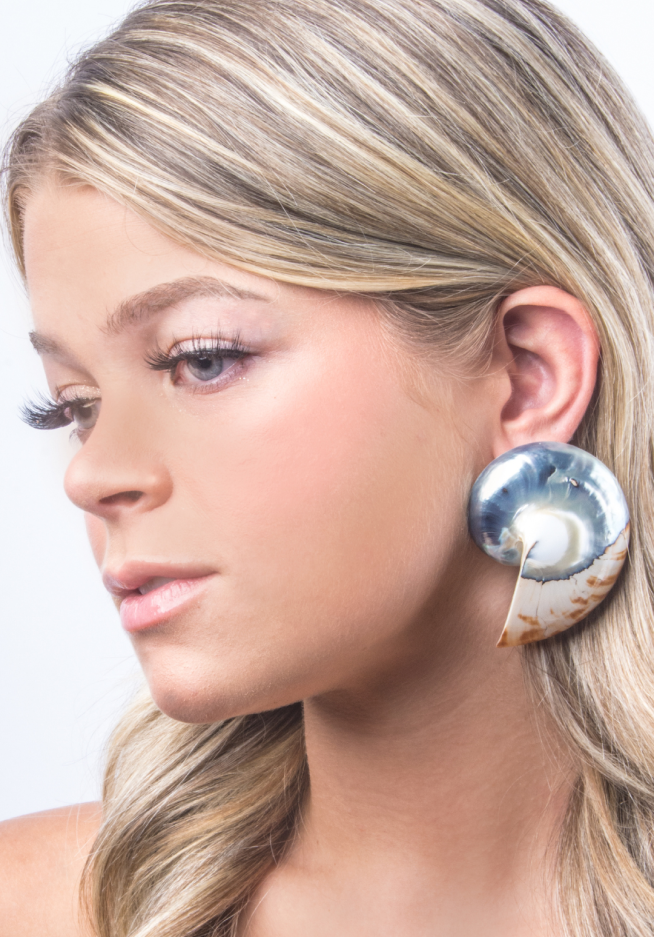
The first pieces drew on the coastline she grew up with — real nautilus and turban shells, set with cultured pearls in baroque and freshwater varieties. The construction approach was carried over from her fashion background: each piece individual, hand-set to order, no batch production.
The Making Process
Afsaneh makes the pieces herself. Where a technique requires specialized equipment or instruction she doesn't yet own, she works alongside other jewelers in the Austin community — mentors who have built long practices of their own and who fold her into theirs as needed.
This is not a romantic claim about craft. It is a structural fact: there is no factory, no overseas production, no batch run. When a customer places an order, the piece is made. That is why lead times exist and why they are listed transparently on each product page.
Why "Lily Frank"
The name "Lily Frank" is not a family name and not a real person. Afsaneh chose it deliberately — a name that lets the brand stand independent of designer-as-personality, with a quiet authority of its own. Plenty of fine jewelry houses are named for their founders. This one is named for an idea.
The choice reflects a broader posture in the work: the maker is present in every piece, but the work itself is the subject. The brand's job is to point at the materials, not at the person who handled them.
Materials and Their Origins
-
01Natural shells
Nautilus, turban, conch. Real specimens, not reproductions. The nautilus spiral is one of nature's more visually compelling structures; to use one in a piece of jewelry is to acknowledge what nature has already accomplished.
-
02Cultured pearls
Freshwater, Akoya, South Sea, and natural baroque. Cultured does not mean synthetic. The nacre is genuine; the pearl is genuine. The baroque variety in particular is non-symmetrical by definition — no two are alike.
-
03Precious metals
925 sterling silver, gold vermeil, and solid 18k gold. The metals support the organic materials they hold rather than compete with them.
What “Made to Order” Means
Two things change when a brand makes to order rather than to stock.
First, the maker stays attached to each piece. There is no batch to optimize, no production run to balance. Each piece gets the attention of someone who recognized the material individually and set it individually. That difference shows up in the finished object — in proportion, in setting tension, in the way a piece sits on the body.
Second, the customer becomes part of the timeline. You order a piece; the piece is made; the piece arrives. That is more friction than a same-day-shipment model, but it is also more honest about what fine jewelry made to order actually requires.
"This is not a positioning statement. It is a structural fact about how the brand operates. On the practice
Closing
Lily Frank Jewelry sits at the end of a long résumé in fashion and vintage, not the beginning of one in jewelry. That distinction matters for what the work looks like and how it is made.
It is a small, deliberate operation in Austin, Texas. Real natural shells. Real cultured pearls. Real metals. Made by Afsaneh Taki, with the support of her local jewelry community, one piece at a time.
Browse Current Pieces
Each piece is made to order in Austin, Texas


Fine jewelry made to order in our Austin studio with real natural shells, cultured pearls, sterling silver, gold vermeil, and solid 18k gold. Every piece is made to order.